We enter the cathedral around midday, when the city is already fully awake. The sun stands high, the sky is clear and the queue moves steadily forward. Yet there is something expectant in the air, as if another world begins behind the heavy walls. The moment we cross the threshold, the atmosphere changes. The light softens, the sounds fade, and the space opens before us with a scale you cannot grasp at once.
You do not view the Cathedral of Seville in a hurry. It overwhelms with its height, its silence and the scent of ancient stone. Everything around you seems designed to draw your gaze upwards and make you pause for a moment. That is exactly what makes this visit so special.
In this blog ...
- A building larger than you can comprehend
- Inside the cathedral
- The Capilla Real and the crowns of Seville
- The tomb of Columbus and his son
- The ascent of the Giralda
- A visit that lingers
- Frequently asked questions about the Cathedral of Seville and the Giralda
- Avoiding queues at the Cathedral of Seville
- Other topics you may be interested in
A building larger than you can comprehend
After the Reconquista, the Christian rulers wanted to give Seville a new identity. Not with a modest church, but with a structure that would show the world the city had entered a new era. According to tradition, the master builders said they wanted to construct a church “so large that everyone would think they were mad”.
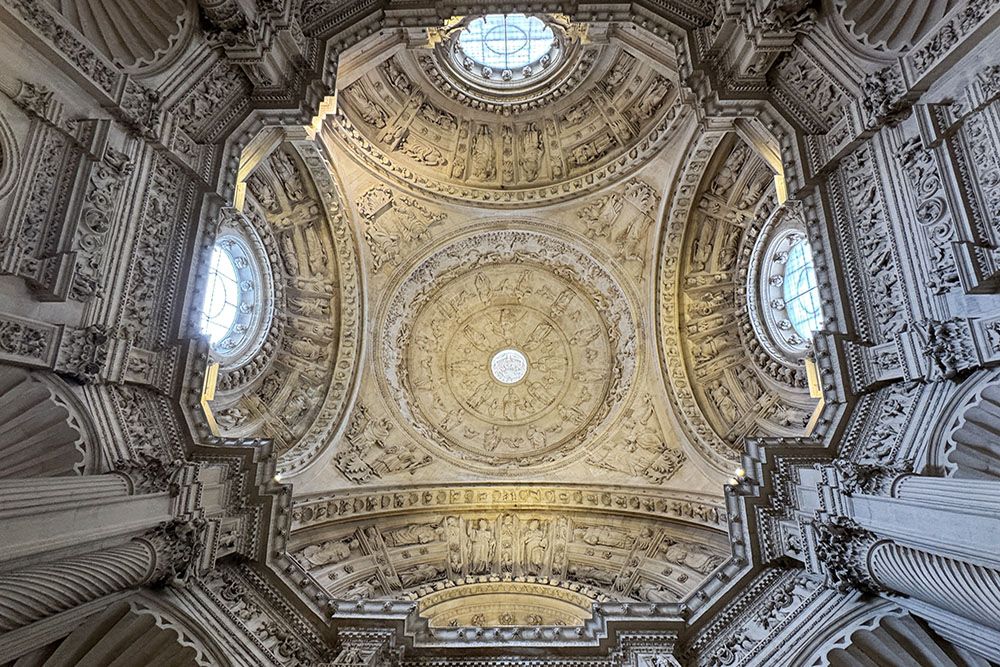
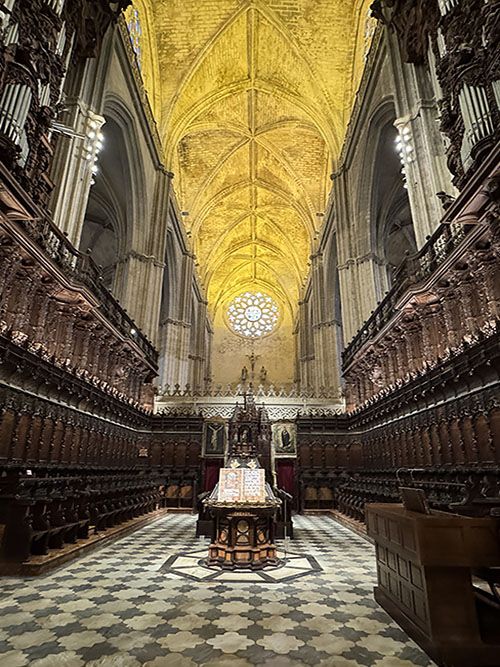
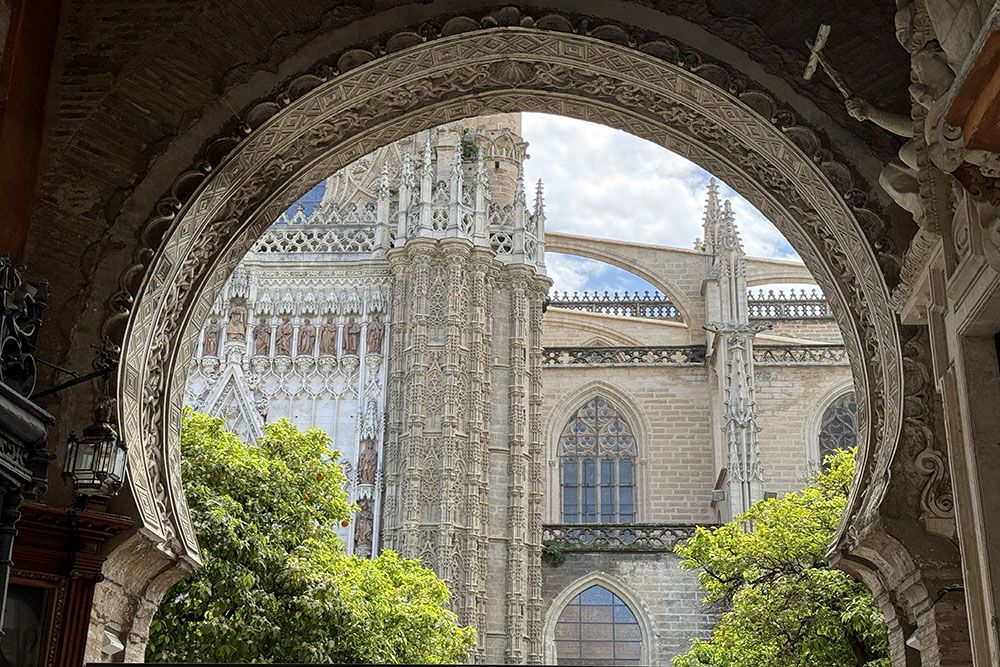
If that was the goal, then they succeeded. Today, the cathedral is the largest Gothic cathedral in the world, and one of the biggest churches ever built. Construction began in 1401 and lasted more than a century; only around 1506 was the Gothic part largely complete. You notice it in everything: the pillars rising like trees, the vaults disappearing into darkness, the scale that keeps surprising you.
Our guide Dori looks up for a moment and smiles. “Here you finally feel how small you are,” she says softly. And that is exactly what happens.
Inside the cathedral
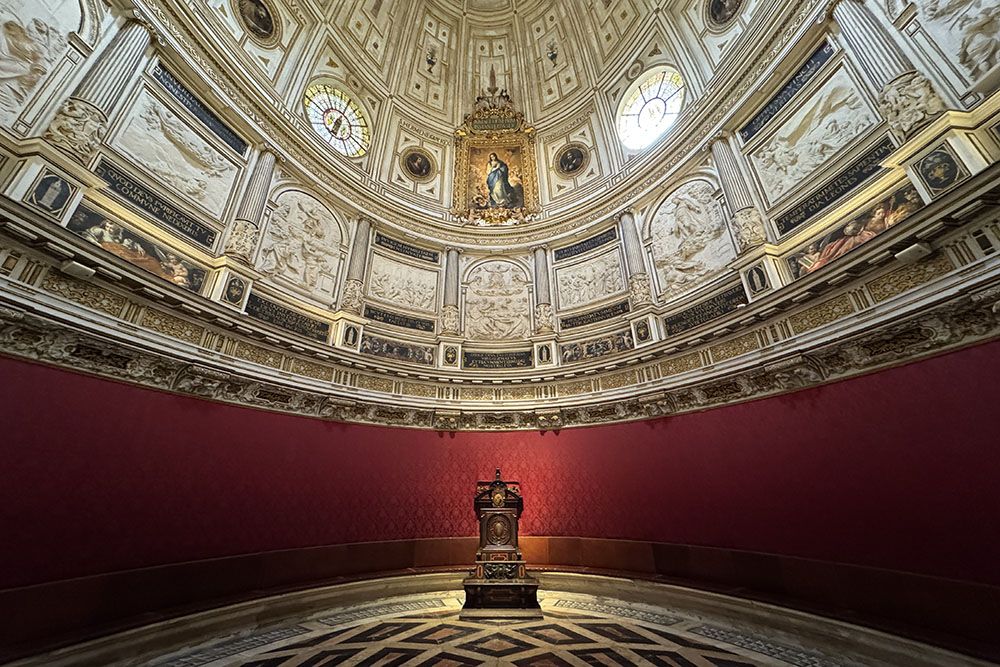
We walk with Dori into the central nave and let the first impression settle. One moment we stand in a wide, bright space; the next in a darker corner where a single candle illuminates a painting. The cathedral does not feel like one large hall, but like a collection of worlds under one roof.
Along the edges of the nave lie dozens of chapels. Some are small and simple, others richly decorated with gold, silver and centuries‑old artworks. You can lose yourself here without realising it. Each chapel tells its own story, its own piece of history. “You can walk around here for hours,” Dori says. “And still not see everything.”
Between all that Christian splendour, traces of the mosque that once stood here occasionally appear: horseshoe arches, rhythmic patterns in stone and wood, and a way of building that lets light and shadow play as if it were part of the design. They are subtle reminders of the centuries in which Seville was an Islamic city. They give the cathedral a depth you do not expect immediately.
A little later, we stop at the two enormous organs facing each other in the transept. The wooden cases are carved so richly they almost resemble altars. Dori’s face brightens. “This is truly special,” she says. “Together they have almost seven thousand pipes.” She says it with a kind of pride, as if she built them herself. It is the kind of detail you might otherwise miss, yet it shows exactly how overwhelming this cathedral is in every respect.
The Capilla Real and the crowns of Seville
Deeper inside the cathedral lies the Capilla Real, the royal chapel. The space feels different from the rest of the building: quieter, darker, almost solemn. Here lie Ferdinand III (San Fernando), Alfonso X and Peter I. The atmosphere is restrained, yet grand at the same time.
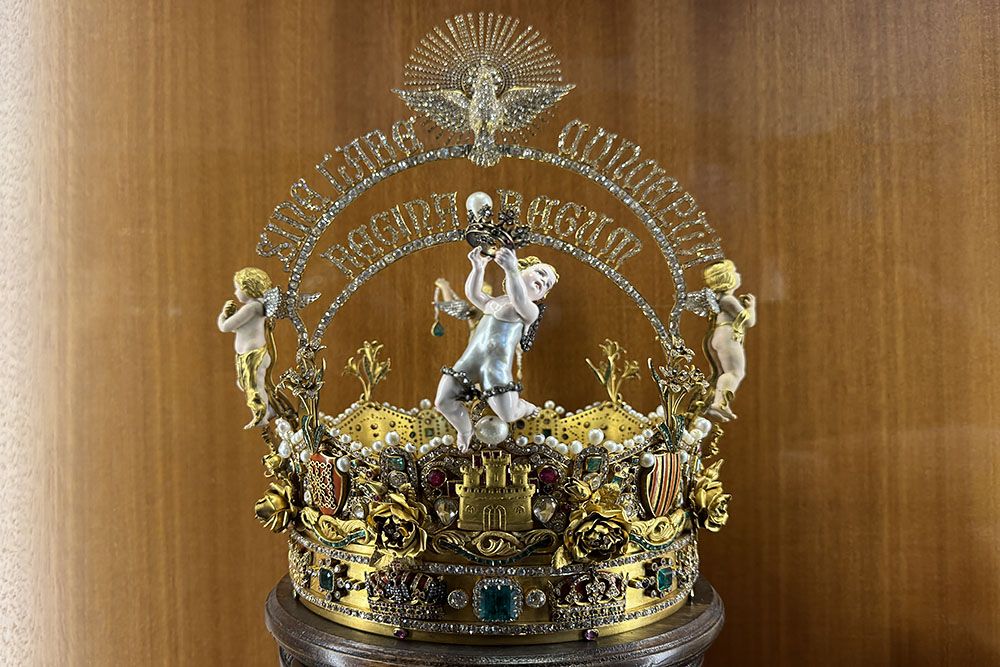
In the centre stands the Virgen de los Reyes, the patron saint of Seville. The crowns used during major religious celebrations are kept for her. These are not worldly crown jewels, but religious crowns that have played a role in the city’s traditions for centuries.
Dori explains that the crowns are not simply displayed: they are still used. This happens during Semana Santa and on 15 August. This is the day on which Seville celebrates the Assumption of Mary. The Virgen de los Reyes is then carried in procession, dressed in her festive garments and wearing one of her crowns.
They are objects you almost hesitate to photograph. They belong to rituals older than most countries in Europe.
The tomb of Columbus and his son
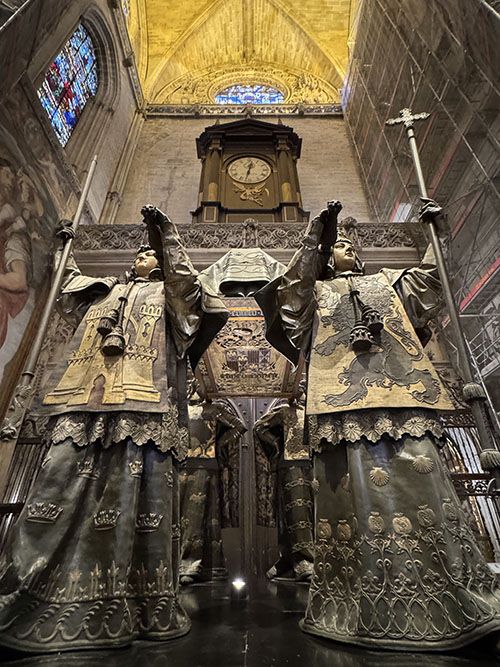
As we continue through the cathedral, the monumental tomb of Christopher Columbus rises in the heart of the space. Four imposing figures carry his coffin. The figures represent the four historical kingdoms of Spain. It is a tomb that almost forces you to stop.
For centuries, people have debated whether his remains truly lie here. Seville insists these are the real bones of the explorer; elsewhere in the world, that is doubted. But here in this cathedral, this is unquestionably the place where he is honoured.
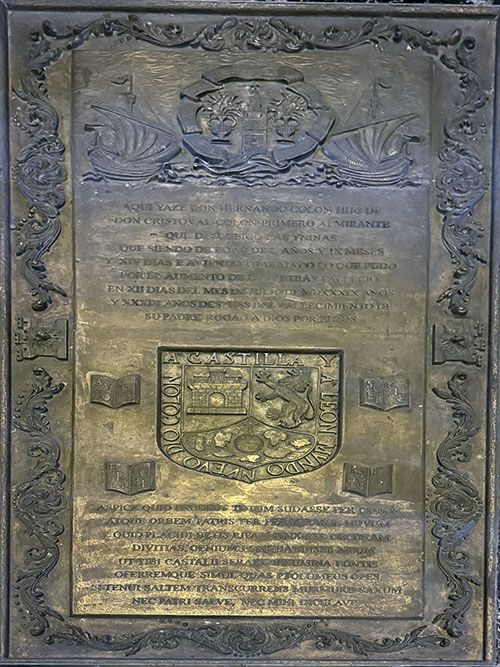
Not far from there, Dori pauses at a large marble gravestone in the floor. The coat of arms, the ornaments and the Latin text immediately draw attention. “Here lies Fernando Columbus,” she says. “The second son of the explorer.”
It is a grave you could easily overlook because it forms part of the floor. Those who look more closely see how richly and carefully it is designed. No theatrical display like his father’s, but an impressive stone reflecting his scholarship and status. A monument that does not impose itself, yet silences you the moment you notice it.
The ascent of the Giralda
When we reach the Puerta del Lagarto, where the entrance to the Giralda is located, we say goodbye to Dori. From here, we continue on our own. We have heard the stories; now it is time to climb the tower and see Seville from above.
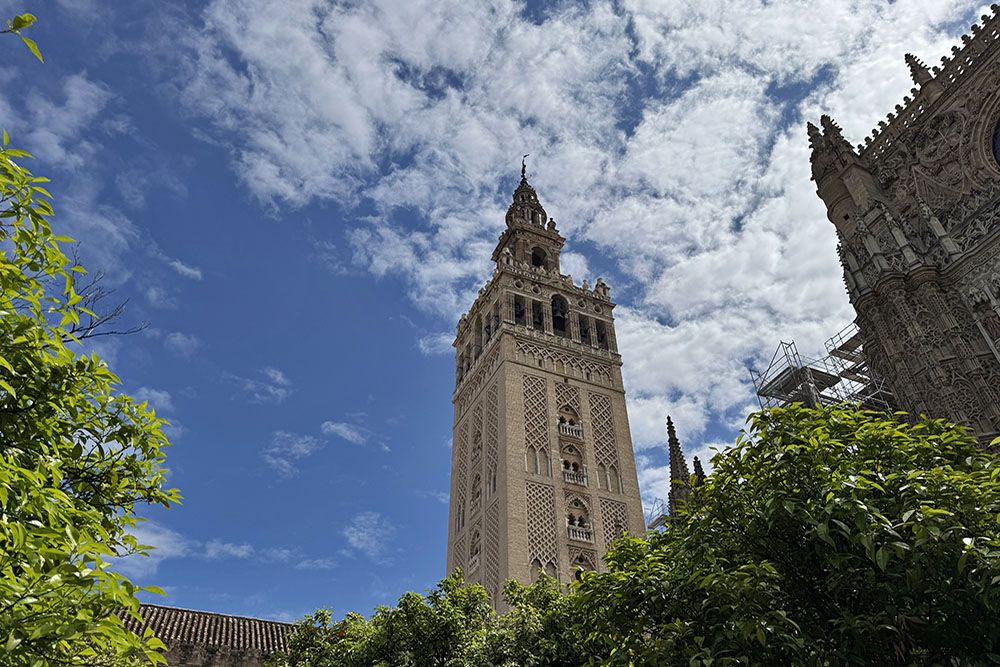
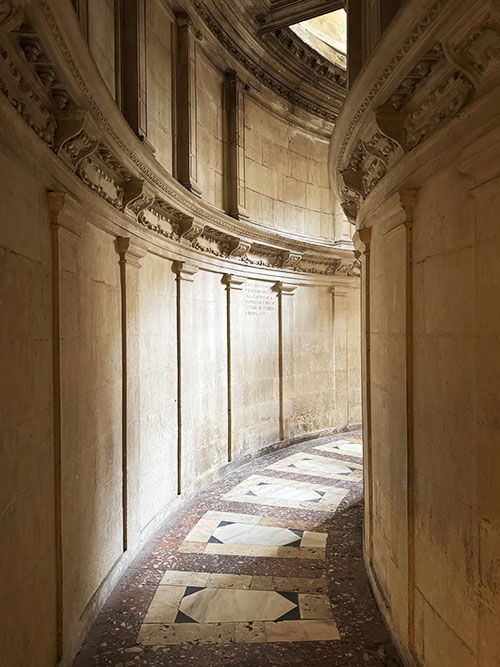
The Giralda was once the minaret of the great mosque that stood here in the 12th century. The Christians later built a bell tower on top of it. The lower part is still entirely Moorish. That is why the way up consists of thirty‑five sloping ramps instead of stairs: the muezzin rode up here on horseback to make the call to prayer. As we slowly ascend, the view changes through every opening: courtyards, rooftops, towers, and each time a little further away from the bustle below.
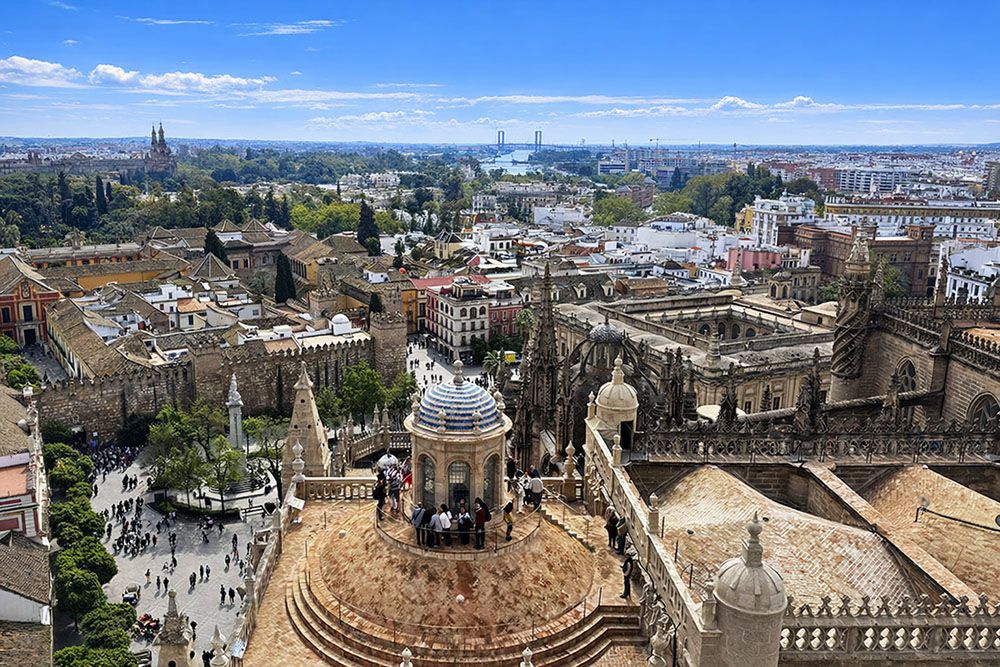
The climb is surprisingly gentle. And at the top, a view awaits that captures the entire city in a single glance: the canal where the Guadalquivir once meandered, the rooftops of Santa Cruz, the patios, the towers. Here, Seville suddenly becomes understandable. We stand still for a moment, without saying anything. Sometimes that is the only thing you can do.
A visit that lingers
When we later stand outside on the square again, it feels as if we have stepped out of another world. The cathedral is not just a building; it is an experience. A place where history, faith, art and power come together.
The city has much to offer, but this monument stays with you. Not only because of its size, but because of the moments in between: a quiet chapel, a whispering guide, a crown worn only a few days each year.
Frequently asked questions about the Cathedral of Seville and the Giralda
The Cathedral of Seville is the largest Gothic cathedral in the world and one of the biggest churches ever built. The building is over 135 metres long, 100 metres wide and almost 42 metres high in the central nave.
Construction began in 1401 and lasted more than a century. Around 1506, the Gothic part was largely completed, after which expansions and restorations continued for centuries.
The monumental tomb of Christopher Columbus stands in the transept, carried by four figures representing the historical kingdoms of Spain. Whether his remains truly lie here is debated, but this is the official Spanish location.
Yes. Fernando (Hernando) Columbus, the explorer’s second son, is buried beneath a richly decorated marble gravestone in the floor, close to the cathedral’s entrance.
The entrance to the Giralda is inside the cathedral, near the Puerta del Lagarto. You can only reach the tower after entering the cathedral.
The Giralda is approximately 104 metres tall and was for centuries one of the highest towers in the world.
Instead of stairs, the ascent consists of 35 sloping ramps. They are wide enough because the muezzin once rode up on horseback to make the call to prayer.
From the top, you overlook the Alfonso XIII canal, the rooftops of Santa Cruz, the patios, the city’s towers and the historic centre of Seville.
The cathedral has two monumental Baroque organs with nearly 7,000 pipes in total. They face each other in the transept and are among the most impressive organs in Spain.
Plan at least 1.5 to 2 hours for the cathedral itself and another 30 to 45 minutes for the climb to the top of the Giralda.
No. A ticket for the cathedral automatically includes access to the Giralda. You do not need separate tickets.
A standard ticket for the Cathedral of Seville, including access to the Giralda, usually costs €12 to €13. It is best to buy tickets online via the official website of the cathedral to reduce waiting time at the entrance.
Yes. You can book both private guides and group tours. A guide adds a lot, because the cathedral is enormous and full of details you would otherwise miss. Many guides are officially certified and offer tours in multiple languages. You can book a guide via the official website of the Cathedral of Seville, where all available tours are listed.
Yes. At the entrance of the cathedral, you can rent an audio tour. It leads you past the main chapels, artworks, the tomb of Columbus and the entrance to the Giralda. The audio tour is available in several languages and is a good alternative if you prefer exploring independently. An audio tour costs €5 for a device or €4 for the app version.
Around midday, you have the clearest view, but in the late afternoon the light is softer and the city photographs beautifully.
We visited Seville at the invitation of the Seville City Office and one of its partners, Época Suites. The content of this blog was created independently and objectively, based on our own impressions.
Avoiding queues at the Cathedral of Seville
Book special tours here with our partner GetYourGuide here. We receive a small commission for your booking at no extra cost to you. This commission helps us maintain this travel blog.